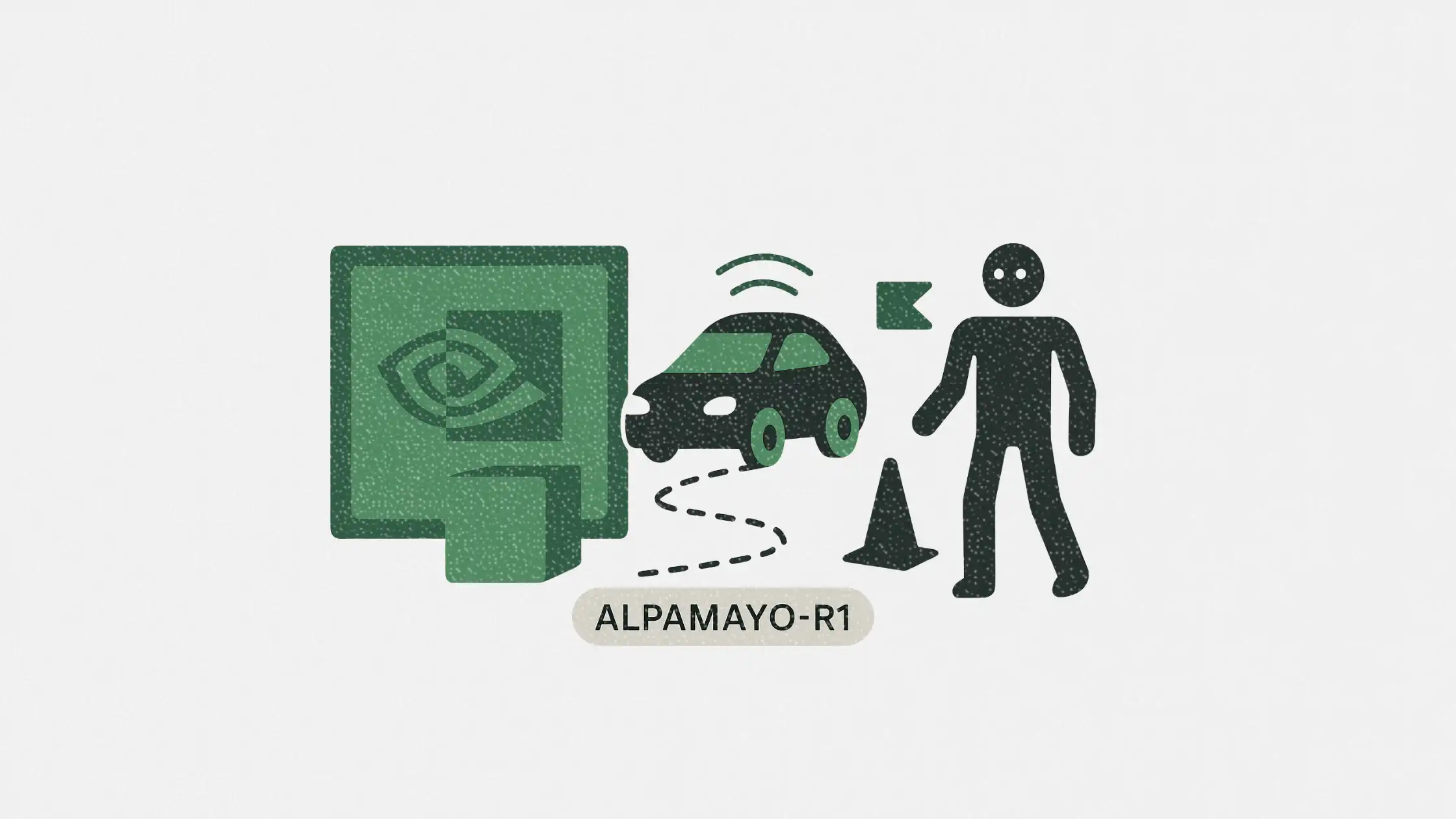
Nvidia has dropped a new suite of AI tools aimed at advancing autonomous driving and robotics, signaling a deeper push into what it calls “physical AI.”
At this year’s NeurIPS AI conference in San Diego, the chipmaker introduced Alpamayo-R1, a new open-source vision-language-action (VLA) model designed for autonomous driving research. Touted as the first reasoning-focused VLA model for driving systems, it combines visual input, language understanding, and logical decision-making to help machines interpret the world more like humans.
This article explores Nvidia’s announcement, how it fits into the company’s broader physical AI strategy, and why marketers and product leads in mobility and robotics should pay attention.
Short on time?
Here’s a table of contents for quick access:
 Patrecia Meliana
What is Nvidia’s Alpamayo-R1?
Alpamayo-R1 builds on Cosmos-Reason, Nvidia’s reasoning-focused language model family released in January 2025 and expanded in August. The new model takes that decision-making logic and merges it with visual and contextual inputs to guide machines through dynamic real-world environments.
This means autonomous vehicles using Alpamayo-R1 could handle edge cases that go beyond hard-coded rules. Think detouring around construction, interpreting hand gestures from pedestrians, or adjusting to unpredictable driver behavior in real time.
The model is freely available on GitHub and Hugging Face, making it accessible to the developer and research communities working on next-gen mobility and robotics solutions.
Why Nvidia is betting on physical AI
While most headlines focus on generative AI for text or images, Nvidia is pushing hard into physical AI. That includes machines that can move, react, and make sense of the physical world—robots, autonomous vehicles, warehouse systems, and more.
Nvidia’s Co-founder and CEO Jensen Huang has repeatedly stated that physical AI is the next frontier. His Chief Scientist Bill Dally echoed that belief earlier this year in a TechCrunch interview, saying Nvidia wants to build the “brains of all the robots.”
The Alpamayo-R1 model supports that mission by adding reasoning to the physical perception stack. Alongside the model, Nvidia released the Cosmos Cookbook, a set of tools and workflows for training and fine-tuning Cosmos models. This includes resources on data curation, synthetic data generation, and model evaluation—all hosted on GitHub.
Together, these releases form a strategic play to cement Nvidia’s relevance not just in generative AI, but in real-world, embodied intelligence.
What marketers should know
This update may seem technical at first glance, but it carries several strategic signals for marketers, especially those in AI, mobility, or robotics sectors.
1. Physical AI is the next brand narrative
Nvidia is reframing AI from digital assistants to embodied intelligence. If your brand touches anything in robotics, logistics, autonomous systems, or smart cities, it is worth considering how your marketing aligns with this “physical AI” shift. Messaging that taps into human-like reasoning in machines could resonate with buyers looking for real-world reliability.
2. Open AI infrastructure is a competitive lever
By releasing Alpamayo-R1 as open source, Nvidia is lowering barriers for R&D teams. If your company offers solutions that integrate with open models, now is a good time to highlight that in product marketing or technical content. This also opens space for partnerships or case studies that showcase compatibility with the Cosmos ecosystem.
3. Developer-first marketing has new momentum
The Cosmos Cookbook is more than documentation. It’s a hook for a specific audience—AI developers and researchers. If your go-to-market strategy includes a developer motion, consider producing use cases, tutorials, or benchmarks that plug into these open Nvidia models. Technical content is now a marketing differentiator.
Nvidia’s Alpamayo-R1 is not just another model drop. It is a calculated step toward real-world AI that thinks before it acts. For marketers in autonomous systems, robotics, or AI infrastructure, this is a clear signal that the frontier has shifted.
Physical AI is becoming a competitive narrative. Whether you’re enabling it, integrating with it, or just trying to stand out in a crowded AI landscape, now is the time to get your messaging aligned.


Leave a Reply